
Recently, I participated in two experiences that were intrinsically linked from separate realms: one event was physical, one event was digital. Together, they led me to better understand the promise and principles of the Industrial Metaverse and sparked a larger question: can more mission driven organizations use these principles to develop new pathways and strategies?
The first experience was riding from South Florida to Orlando on the new(ish) eco-friendly and high-speed Brightline train, the only private intercity rail line in the United States. I love trains and am grateful to have had the opportunity to ride the rail from Shanghai to Beijing and other top train rides in Norway and Sri Lanka. I had been excited to ride Brightline for weeks even though Brightline’s current financial future continues to be determined based on ridership. The experience didn’t disappoint, especially since a friend had prompted me to listen to New Blue Sun during the commute and I spent time in deep reflection on the journey as a result of this liminal combination, marveling at both industrial and personal reinvention.
The second event was more spontaneous and more recent: I visited a local makerspace for entrepreneurs and signed up for an intro course on Computer Aided Design (CAD) software. After two hours of instruction, fumbling clumsily through the instructions, and several clarifying questions, I completed a shoddy virtual nameplate that I could manipulate in the CAD software in the lab’s digital environment (i.e. desktop computer).
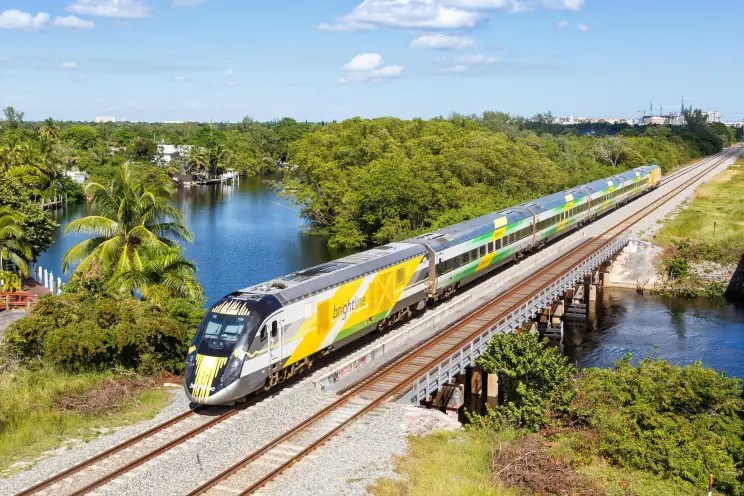

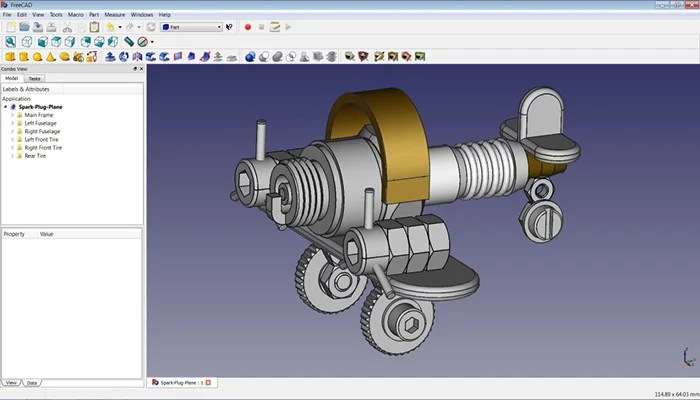
Above: images of a Brightline train and Computer Aided Design Software demos
Computer Aided Design, an industry that has been in existence since the 1950s, shapes our constructed physical world in almost every imaginable way now — everything from running shoes to airplane engines begin the design process in CAD software where industrial designers manipulate digital prototypes, run animated simulations based on principles of physics, and analyze the results for optimization against preferred parameters. Once satisfied, resources are finally committed to physical manifestation.
The power of testing and freedom of experimentation that CAD software enables fully struck me while recently watching the 2024 Consumer Electronics Show (CES) keynote presentation from Siemens’ CEO, Roland Busch. In it, Roland breaks down the future of Siemens’ strategy with a primary emphasis on the Industrial Metaverse, the convergence of individual technologies that, when used in combination, can create an immersive three-dimensional virtual or virtual/physical industrial environment (Deloitte).
In the case of Siemens’ approach, Roland walked through the technologies they’re combining to create their version of the Industrial Metaverse: Computer Aided Design, Virtual Reality, and Pixar’s open-source Universal Scene Description (USD) technology, “the first open-source software that can interchange 3D scenes that may be composed of many different assets while fostering highly collaborative workflows.”
Pixar visualizes how USD technology enhances their movies in this silent clip from Toy Story 4:
When Computer Aided Design, Virtual Reality, and Universal Scene Description Technology intersect, powerful design and collaboration tools result and engineers, designers, architects, urban planners, and others can manipulate, test, and iterate in a robust, low-cost, and low-risk virtual environment that operates based on parameters from contexts and interactions that are relevant in the physical world.
After watching Siemens’ promotional keynote at CES, I assumed that the industrial metaverse (or at least an earlier version of it with CAD software) had powered my recent high-speed rail trip on the Brightline train. Sure enough, I learned that the trains were manufactured by Siemens Mobility. It’s not just Brightline of course: whether it’s a process flow for a factory warehouse, a steering wheel on a car, or affordable nutritional supplements to combat malnutrition, ideas can be tested prior to creation in digital or virtual environments, saving a tremendous amount of time and resources. In addition, artificial intelligence is already integrated to enable the virtual design process to eliminate real world process challenges or disruptions that would otherwise only be identified in physical environments. Beyond initial sentiments of optimism, the questions I was left with from Siemens’ CES presentation were:
- How will virtual design teams in the industrial metaverse be inclusive to ensure our physical future in the real world is safe and equitable for all?
- Beyond just industrial applications, will there be ways for mission driven organizations to model strategies and assumptions in virtual environments?
- How will virtual tools continue to better reduce economic extraction and greenhouse emissions early on in design processes?
Once you see how the Industrial Metaverse will likely continue playing a leading role to scaffold our world, it’s difficult to unsee it. It also provides a potentially more inspiring case for continued exploration of the metaverse: rather than the use case for the metaverse being to escape the real world, does the use case becomes much more motivating when it’s to co-design the real world in a more sustainable, more collaborative, and less resource intensive way?
Regardless of your level of inspiration from this sentiment, the power of collaboratively and comprehensively testing an idea in a virtual environment using a “digital copy” that can be tested and manipulated as if it is a physical object is now painting our future from the clothes we wear, to the transportation we ride in, to the shared infrastructure that enables our coexistence. The future always becomes the present and although it often seems overwhelming to keep up, these design and collaboration opportunities may give hope for humanity’s ability to build a sustainable, people centered, and eco-friendly economic transition with global asynchronous collaboration and shared learning across countries and continents.
Reflection Questions:
- How do you wish to scaffold the world?
- What questions do the industrial metaverse bring up for you?
- What opportunities and concerns do you see as virtual design shapes our future?
Resources & Credits:


 Mission Driven Strategy and Operations
Leave a comment